Wednesday, April 27, 2011

Bear Necessities of Rounding

Counting Bears have been a bear necessity for our home school.
I remember eyeing them in Wal-mart,
waiting for the day I could afford them.

When I found another set at a garage sale,
I was ecstatic. 
It felt better than that dream
of picking up money in the streets,
cuz this was real.

Doesn't take much to make the
Momma of home-teached kids happy,
does it?

 
I said that on purpose - remember the name of my blog?

Any-hoo, we were trying to learn the
concept of rounding to the nearest ten.
As always, the first time a concept can be introduced,
it can be confusing.

First time mastery brings confidence and enjoyment to any subject.

I pulled out my pile of tricks from overstuffed and underorganized shelves and got to work.


We started with the laminated number line that goes from 1-100.

A small bear was placed on the number 18,
the number we needed to round.

Rebekah had to tell me the two tens her number was between,
in this case 10 and 20.

Large bears were placed on the tens.
If your items aren't different sizes, you could differentiate with colors.


At a glance, she could tell the 18 was closer to the 20.


(double-click to enlarge and print)


We repeated with different numbers,
emphasizing the rule~

numbers ending in 1-4
are rounded down,
numbers ending in 5-9
are rounded up.


Yep, counting bears
are the bear necessities
of a hOme tEaChEd life.


Monday, April 18, 2011

Playing In Math Class

Beka and I love to play together.
We play dolls, store, raft, school, restaurant, store and servant.
She always lets me be the boss and she's the servant, isn't she sweet?

It's hard to do school when you wanna' play,
so we like to play during school.

It greatly improves math skills.

So does scratching your head, we learned.

In 2nd grade, Beka is learning money skills.
The worksheet introduced the concept of counting back change.
Having a cash register with a calculator and a change drawer that
"dings" when you open it, is a must for math class.

The worksheet was  kinda' confusing.
It was kinda' boring, too.
If Teacher Momma Mindy is bored,
I know my student is bored.

When the head scratchin' didn't help enough,


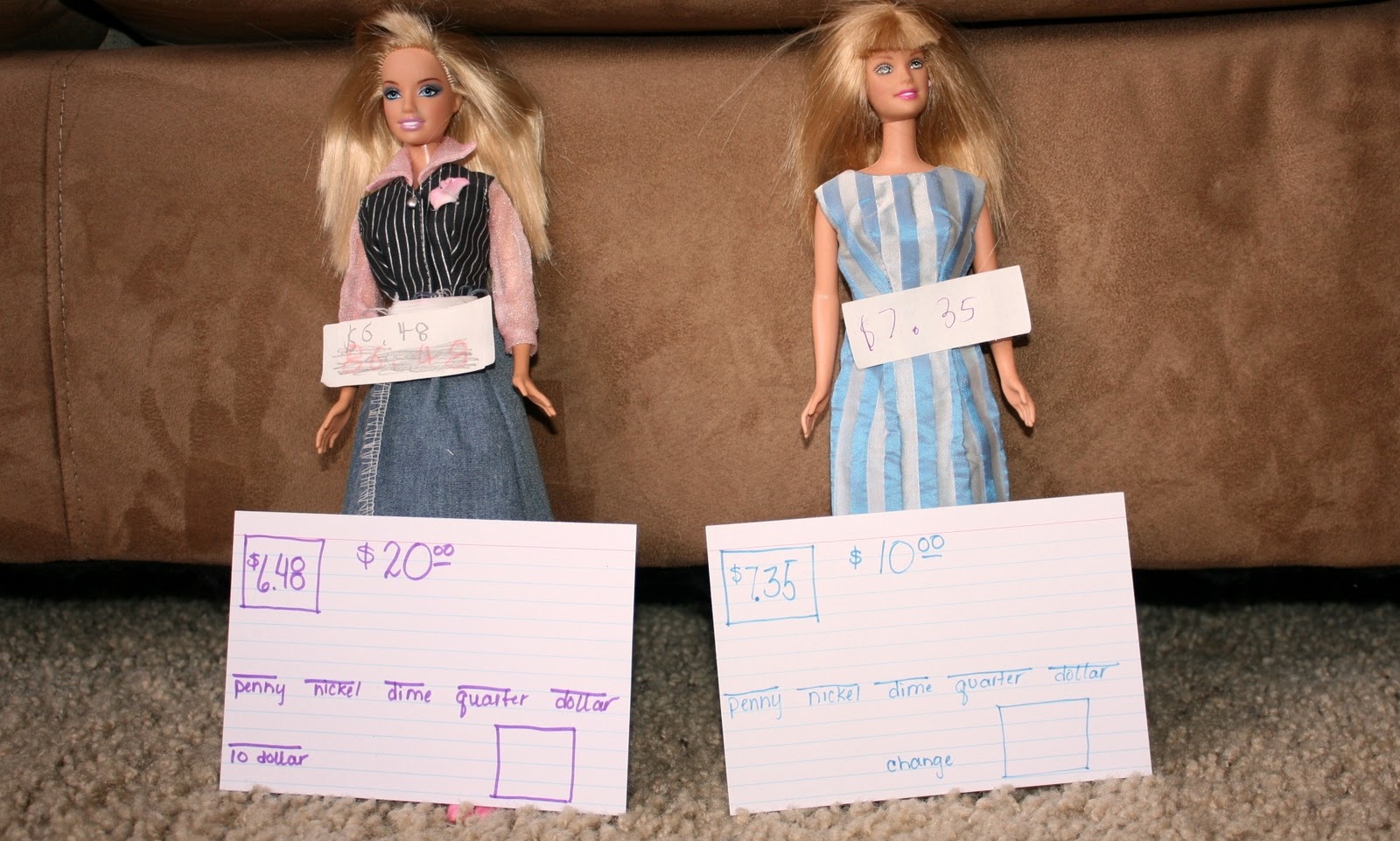
We opened a store.
While Beka priced her toys, I scribbled quick cards for each item.


The box on the left is the price, the bill used to pay is in the middle.
She had to use $5, $10 and $20 bills.

First, she had to figure out change, using the lease amount of each coins.
 Then, I came into her store many times, in character,
buying gifts for nieces, spoiled children, brats, and kids having birthdays.

She recommended an item, took my money, and counted back my change.

After I bought out the store, she had nailed the concept.

We went back to the boring worksheet, and finished it in a few minutes.
I'm thinkin' boring doesn't always mean just boring.
Confusion can bring on boredom.
When you are confident and understand,
math isn't boring, it's exciting.
Then, we played, because that's what we like to do.

We play.

Monday, February 7, 2011

Ramen Noodles and Roman Numerals

I know Ramen Noodles are for eating
 and Roman Numerals are for counting,
but sometimes my kids get mixed up.

My older kids, who were allowed to eat Ramen Noodles on occasion,
used to get frustrated when learning their Ramen Numerals,
but wanted Roman Noodles  for lunch.

 Due to dietary decisions, we have nixed the Ramen Noodles
and kept the Roman Numerals,
although we still get them mixed up on occasion.

A visual person, I've learned I teach better according to my style. 
When the kids were having a hard time grasping  Roman Numerals,
a concept  we don't often use except in math class,
I needed to land the learning so they would have success for a lifetime.

I invented Roman Numeral Tiles.


 One inch squares of Fun Foam were labeled with a permanent marker. 
This lesson we were just learning to count from 1-30.


The patterning makes it very easy to understand the rules of
adding consecutive numbers together,
subtracting a lower number when placed before a larger number,
and not using a number more than three times in a row.

When set out in numerical order the beautiful number patterns
also remind us of a God who created in pattern and order.


To test her skill, I quickly made number cards,
and had her use the tiles to show the Roman Numeral equivalent.

When she stumbled with 19, I reminded her it's 10 + 9,
then she quickly found the correct tiles.

It takes a little extra time to pull out the manipulatives to enforce a lesson,
but it's time that usually won't need to be repeated.

A longer introduction to a concept,
followed by a few short reminders,
is more successful than a short introduction,
and a lot of lengthy reminders.

I found a  few free Roman Numeral worksheets from abcteach.


Your kids can enjoy a cute computer interactive game by Tullie House,
playing Snakes and Ladders with Roman Numerals.

I gave up trying to find a free bingo game,
they all wanted me to buy or subscribe to something,
so I made my own.
Yea, right in the middle of trying to blog, finish up school,
prepare for a meeting, and eat dinner,
I had to make a bingo game.

Stay tuned. I have another fun way to learn Ramen Numerals.

Tuesday, January 4, 2011

The Borrowers

Nuttin' like startin' out the second semester with a bang.

Our first day back, after two glorious weeks of vacation,
and Beka had to learn borrowing.

It is one of the hardest concepts for lower elementary kids to grasp.
Being patient while teaching one of the hardest concepts
is one of the hardest challenges for those teaching lower elementary kids.

At first, my patience was STILL on Christmas vacation!

Quickly, I had to get back into the calm, praying teacher mode,
so I didn't add to her frustration.


I took out all the tools.


Place value was quickly reviewed, then Beka wrote the problem
31-28
with the digits in the correct columns on my place value chalkboard.


This THING is amazing.
It's old, it's cool, and it helps visual learners.

If you can't find a vintage THING like this,
you easily could use Legos or Duplos.
 Or, if you don't have little ones crawling around eating your manipulatives,
you could use pipe cleaners and pony beads.

Look around....there is probably something you could use...

When you show tens as a unit,
it is much easier to understand the concept of carrying and borrowing.
Instead of saying you're borrowing "one"
it is helpful to say you're borrowing "one ten."

Here we borrowed one ten from the tens column,
and placed it in the ones column.

Instead of 31, we made 20 + 11.
We don't change the amount,
you never create or destroy matter,
you just changed its clothes.

This is why modern curriculums call it "regrouping."
I guess it is more accurate, because you're not borrowing
like you're going to return it, you use it and don't give it back.

It is good to introduce all the terms you know for any concept,
you never know what they'll be called on testing, or in different curriculums.


We practiced several times before we began the worksheet.
I had her physically move the group of ten over to the ones column
for each problem we did.

You get to touch your math,
you get to see your math,
you get to hear your math
with mom using manipulatives.

When math isn't working with numbers, I talk about candy.
"You have only three pieces of candy and you
need to give me seven pieces of candy.
You have to borrow ten pieces of candy from your sister next door."

Sometimes, it grabs their attention long enough to grasp the concept.

It still wasn't clicking, so I brought out another manipulative.

Yea, Dad!

This was his last day of vacation,
then I am on my own.

I'll make sure my patience comes back to school with me.


Wednesday, December 8, 2010

Is $1 Cheap Enough?

I am always looking for an inexpensive and quick
 learning manipulatives.

File folder games work well for me because they are easy to store,
and can usually be self-correcting.


During back to school shopping,
Target sold file folder games in their dollar section.

That's cheap enough for me!


Using one of my favorite DIY tools,
self adhesive laminating sheets,


I quickly covered the game board...

and the pieces.

A cheaper and easier to find alternative is clear Contact paper,
but the laminating sheets are clearer and a bit stiffer.

Then using another favorite tool,
my little cutting thing,
I cut apart the game pieces.

DONE.

You can use the pieces as a memory game,
with pieces turned down,
or as a matching game,
where you put down one set of cards,
then match up the second set.


The only caution in buying school materials not created by
educational companies, is to watch for inaccuracies.

I bought a poster from a dollar store that was missing
several letters from the Spanish alphabet.

Some math booklets and games progess too quickly for age level.
You don't want to jump from 2 + 2 = 4
to
8 + 9 = 17

A phonics item might use words that begin with the correct letter,
but not the correct phonetic sound.

Church would NOT be a good clue word for the letter "c."

The Dollar Tree stores have been known to occasionally
get a small shipment from Evan Moor company.

Be on the look out for inexpensive, easy and accurate
 manipulatives to enhance your curriculum.

What inexpensive treasures have you found lately?

Thursday, December 2, 2010

Why I Teach Health

At first it seemed a waste of time.
I thought Health curriculums, especially in the younger years,
just taught things that Moms should be teaching at home - 
combing hair, brushing teeth, manners and nutrition.

In the older years, they were teaching things I
DEFINITELY
wanted to be the one to  introduce to my children.

Then, I learned what other parents have sadly learned.

Just because I am teaching it, doesn't mean my kids are learning.

Physically hearing doesn't impart knowledge,
physically hearing along with a willingness to comply
 and believe imparts knowledge.

I have also learned that kids are slower to believe what I tell them because, well,
I'm just their Mom.

Not dissin' my kids, just stating a fact.

Point in case, coint in pace, CASE in POINT....I always get that mixed up...

This morning my daughter, Rebekah, said, "Mom, did you know..."

(When they say this, not only do I know, I probably told them no less than 100 times.)

"...that you're supposed to wash your hands several times a day?"


Seriously?

Like I have said that, stated that, demanded that,
ok YELLED that
a gajillion, bajillion times?

REALLY?

Kids believe other people. 
It's a sad fact. 
My oldest daughter came home from her four months stint in 2nd grade public school
 and insisted horses used to have toes. 
No matter what creation things we showed her, she wouldn't budge.

It's a frightening truth that can be used for your advantage.

Kids believe other people. 
My daughter washes her hands and combs her hair
several times a day because her book told her.

I'm not washing my hands of this health curriculum, that's for sure.

Wednesday, November 24, 2010

Keeping Place Value in Its Place

Place value can be a mystifying concept to young children.

Place value can be a mystifying concept for adults
trying to teach  young children.


I like to use various methods to help my kids gain understanding.


I found this old place value chalkboard,
that gives a great visual of the place value columns.

We write the numbers with the digits in the correct column.

When comparing numbers, it is easy to see which number is the least
and which is the greatest.

It also comes in handy for learning to carry,
or regroup, as some curriculums call it.

Plus, it is just fun to write with chalk,
isn't it?


To utilize a place value chart,
you can make paper charts,
they're easy to find on the internet.

You could also make your own gridlines
 on a chalkboard or a dry erase board.

Anybody else have any great ideas for teaching place value?